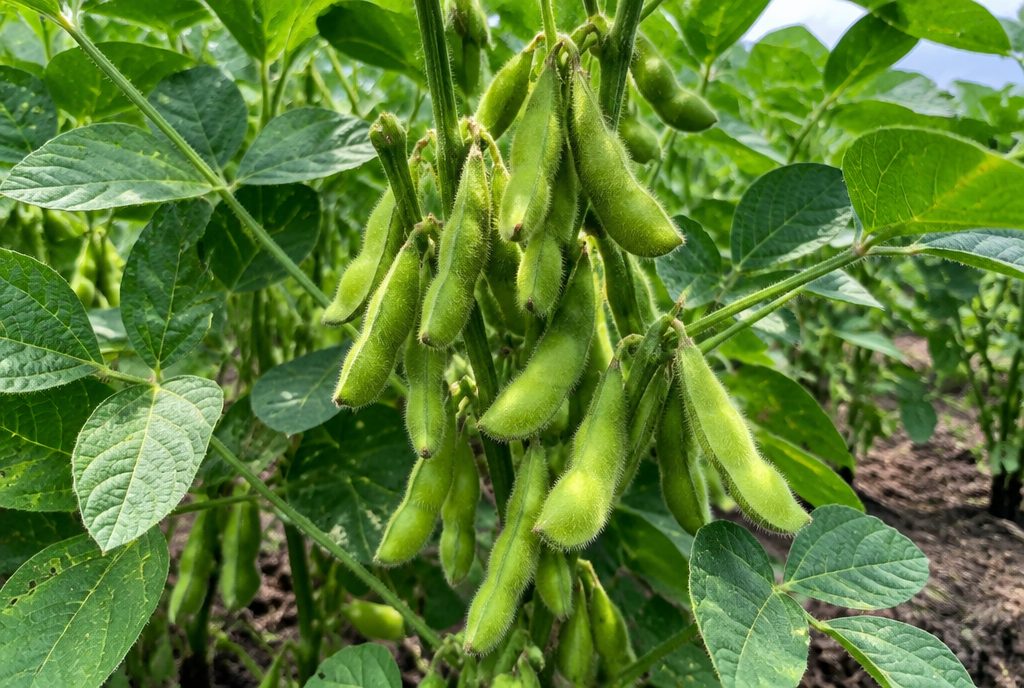
You can grow edamame in most US gardens that have a warm summer: sow the seeds outdoors after danger of frost is past and pick the pods 70 to 90 days later. Edamame is a soybean grown for its green, full pods. Utah State Extension says to plant seeds 2 inches (5 cm) apart and about 1½ inches (4 cm) deep in rows 12 to 18 inches (30–45 cm) apart, and to keep the soil moist until the seedlings come up. The skill is the harvest: pods are best picked at a precise stage, so timing matters more than technique.
- Days to harvest
- 70–90 days after planting
- Origin
- Asia
- Sow
- After danger of frost is past
- Depth and spacing
- 1½ in (4 cm) deep · seeds 2 in (5 cm) apart
- Row spacing
- 12–18 in (30–45 cm)
- Harvest stage
- Green, full pods at about 85% pod fill
- Good pod
- 2–4 seeds, about 2.5 in (6 cm) long
Why grow edamame
Edamame is a soybean harvested while the pods are still green, rather than left to dry. The Iowa State report we use calls them “edamame soybeans” and says they should be picked when the combination of sugar, amino acid content and pod fill is optimal. At home, that gives you the advantage: you decide when to pick. It is also a short-season crop by garden standards, with a harvest range of 70 to 90 days after planting (Utah State).
Where and when can you grow edamame?
Our sources do not give a USDA zone range, a minimum soil temperature or a sunlight requirement, so we will not invent them. What they do give is timing relative to frost and one real-world dataset. Utah State says to plant after danger of frost is past. Iowa State’s trial ran across several fields in 2002, with plantings from May 30 to June 14 and harvests from August 21 to September 14. That is a single season, in one state, in organic fields, so use it as an example of one climate’s schedule, not as a rule.
What the Iowa State trial can teach a home gardener
The Iowa State report is a research trial, but its details are useful if you read them carefully. Three varieties were planted at 125,000 seeds per acre in organic fields, with plantings from May 30 to June 14 and harvests from August 21 to September 14, 2002. On August 21, a mechanical bean picker harvested two 20-foot rows when the pods were green and full. Bean leaf beetles were present, although plant health was not impacted.
Our arithmetic: 125,000 seeds per acre works out to about 3 seeds per square foot. Utah State’s garden spacing of seeds 2 inches (5 cm) apart in rows 12 to 18 inches (30–45 cm) apart works out to roughly 4 to 6 seeds per square foot, so a garden row is denser than a field trial. Neither source says which is better for yield, so follow Utah State’s spacing for a home bed.
Edamame varieties
The Iowa State trial compared three varieties: IA1010, IA2040 LF and Kenko. It reports one clear finding, that averaged across all sites Kenko had a significantly lower stand compared to the other varieties. It does not give days to maturity, flavor or yield figures per variety in the text we could use, so the table sticks to what is documented.
| Variety | Best for | Planted | Stand count | Notes |
|---|---|---|---|---|
| IA1010 | Named in the Iowa State 2002 trial | May 30–June 14, 2002 | Higher than Kenko | Trial seeded at 125,000 seeds per acre |
| IA2040 LF | Named in the Iowa State 2002 trial | May 30–June 14, 2002 | Higher than Kenko | Trial seeded at 125,000 seeds per acre |
| Kenko | Named in the Iowa State 2002 trial | May 30–June 14, 2002 | Significantly lower than the others, averaged across all sites | Trial seeded at 125,000 seeds per acre |
The Iowa State work was a research trial of varieties for growers, not a home-garden shopping list. We do not know which of these seed lines you can buy in small packets. When choosing a packet, look for one sold as edamame or vegetable soybean, and remember that stand, meaning how many seedlings come up, is a variety trait the trial actually measured.
Counting forward from your sowing date
Utah State’s 70 to 90 days is the most useful number in our sources, because it lets you plan from any date. By our arithmetic:
- Sow on May 15: pods from about July 24 to August 13.
- Sow on June 1: pods from about August 10 to August 30.
- Sow on June 15: pods from about August 24 to September 13.
The Iowa State harvest dates, from August 21 to September 14 after plantings between May 30 and June 14, are a different measure. The first planting (May 30) and first harvest (August 21) are 83 days apart, and the last planting (June 14) and last harvest (September 14) are 92 days apart, so the trial sits at or just past the top of Utah State’s range. Treat 70 to 90 days as a guide and let the pods have the final say. Check them every few days once you reach the early end of your window.
Edamame planting calendar
| Zones | January | February | March | April | May | June | July | August | September | October | November | December |
|---|---|---|---|---|---|---|---|---|---|---|---|---|
| Zone Iowa trial: direct sow May–Jun; harvest Aug–Sep | May: direct sow | June: direct sow | August: harvest | September: harvest |
- Direct sow
- Harvest
How to plant edamame
- Wait for the frost to pass. Utah State says to plant seeds after danger of frost is past.
- Mark your rows. Space rows 12 to 18 inches (30–45 cm) apart.
- Sow the seeds. Place seeds 2 inches (5 cm) apart and about 1½ inches (4 cm) deep.
- Keep the soil moist. Utah State says to keep the soil moist until seedlings emerge.
- Plan for a long, even harvest. Work out your harvest by counting 70 to 90 days from sowing, and consider spreading sowings across a couple of weeks, as the Iowa State trial’s planting dates did. See our edamame harvesting guide for the staggered plan.
Edamame care
Water
Sun and soil
Spacing
Pests
Common edamame problems
Harvesting edamame
Pick when pods are green and full. Iowa State says edamame is usually harvested at 85 percent pod fill, and that high-quality pods have 2 to 4 seeds and are about 2.5 inches (6 cm) long. Pod color and size are quality indicators. Iowa State also says insect- and disease-free pods should be harvested, so leave damaged pods behind. After picking, chill the beans for 3 to 10 hours to limit sugar and amino acid degradation, which means the work does not end when the pods leave the plant. For the whole routine, see our edamame harvesting guide.
Is edamame hard to grow?
Judging by our sources, the growing is the easy part. The problems they record are mild: bean leaf beetles that did not affect plant health, and one variety with a lower stand. There is no disease list, no special soil and no long wait. The difficulty is timing. Sow after the last frost, count forward 70 to 90 days, and be ready to pick when the pods are green and full, because the quality of the crop depends on catching that stage. The main extra work is a few minutes at the bed every few days as your window opens, feeling for pods that are plump and measuring them against the 2.5-inch (6 cm), 2-to-4-seed standard Iowa State describes.
What our sources do not tell you
The two sources behind this guide are an Iowa State research report and a Utah State garden article. Between them they leave out sun, soil, pH, zone, container, sow-indoors and frost-tolerance details, and they give no per-variety days to harvest. An Oregon State publication on edamame exists, but its text was not available to us, so we have not cited it. If you grow edamame in the South or the Pacific Northwest, check local extension advice for timing.
Frequently asked questions
When do you plant edamame?
After danger of frost is past, according to Utah State Extension. In the 2002 Iowa State trial, edamame was planted from May 30 to June 14 and harvested from August 21 to September 14.
How long does edamame take to grow?
Utah State says pods are ready to harvest 70 to 90 days after planting.
How deep and how far apart do you plant edamame?
Utah State says to plant seeds 2 inches (5 cm) apart and about 1½ inches (4 cm) deep, in rows 12 to 18 inches (30–45 cm) apart.
How do you know when edamame is ready to pick?
Iowa State says edamame is usually harvested at 85 percent pod fill, when sugar, amino acid content and pod fill are at their best. High-quality pods have 2 to 4 seeds and are about 2.5 inches (6 cm) long.
How should you store edamame after picking?
Iowa State says chilling beans for 3 to 10 hours after harvest helps limit sugar and amino acid degradation.
Sources
- Organic Edamame Variety Trial (2002), Iowa State University Extension
- What Is Edamame and Should I Grow It?, Utah State University Extension
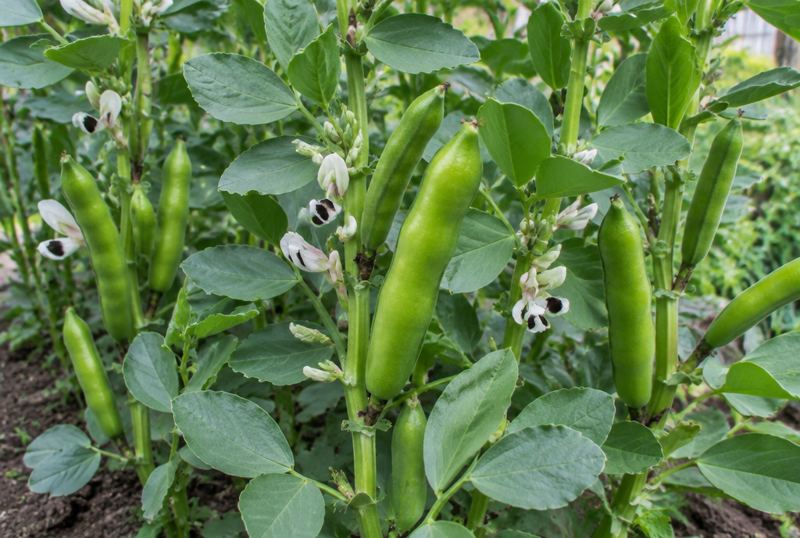 Fava Bean
 Mung Bean
 Yardlong Bean
 Black Eyed Pea