

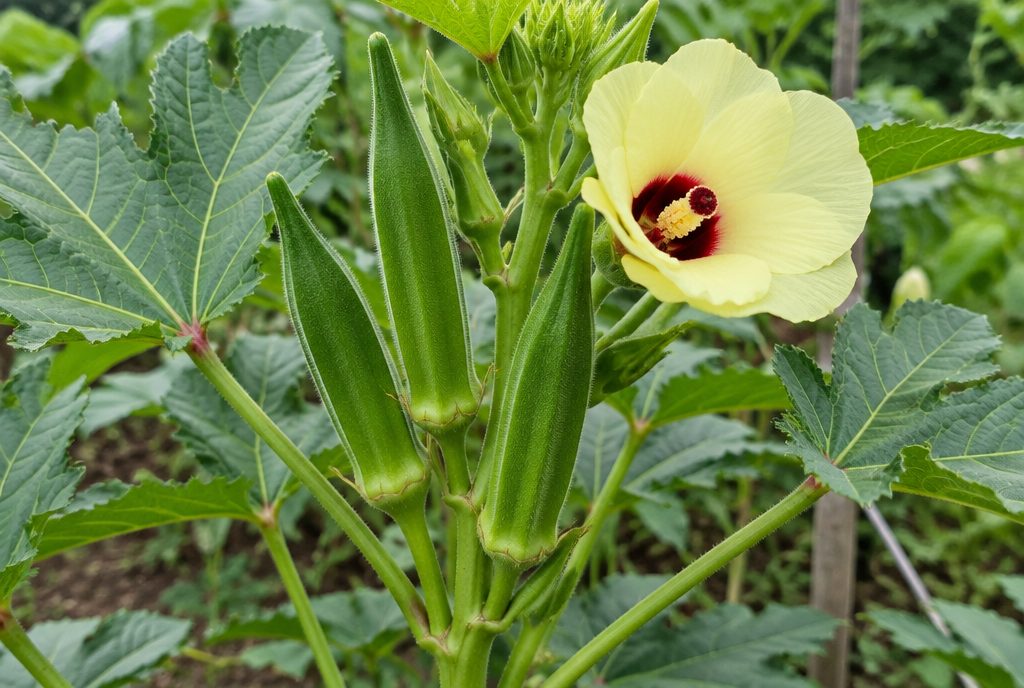
Okra grows from direct-sown seed: wait until the soil is at least 65°F (18°C) at 4 in. (10 cm) deep, sow ¾–1 in. (2–2.5 cm) deep, and thin to one plant per hole. That is the whole method, and the only real decision is when. Okra is a warm-season vegetable (UGA), and its seedlings are the vulnerable stage, because Clemson calls root-decay diseases that kill young seedlings the most serious okra disease problem. This is a supporting guide to how to grow okra.
The soil temperature rule
Cold, wet soil is where okra loses seedlings (Clemson). UGA says to plant only when soils have warmed to at least 65°F at a 4 in. depth. Clemson repeats the 65°F figure and says that if soil is cooler, hold off until it warms. Clemson gives 70°F to 95°F (21–35°C) as the optimum range for seed germination. Texas A&M says that in spring you should plant 2 to 3 weeks after all danger of frost has passed.
Use a soil thermometer pushed in to 4 in. (10 cm) and check in the morning and afternoon. The sources set the minimum; do not sow at 60°F and hope.
Should you start okra indoors?
NC State says that if grown from seed, you should ensure temperatures remain above 55°F (13°C), or start indoors. Neither NC State nor the other sources give a lead time, pot size or transplanting instructions, so we cannot give you a “start six weeks early” rule. If your spring warms late, the direct-sown route with patience is the one our sources describe in full.
Does okra seed need soaking?
Some gardeners soak okra seed before sowing, but none of the four extension sources we used mentions it. We leave it out. What the sources do say is simpler: warm soil, shallow planting and consistent moisture.
How to sow okra seed
- Check the soil. 65°F (18°C) at 4 in. (10 cm) deep is the minimum (UGA, Clemson).
- Prepare the bed. Full sun, fertile, well-drained soil (Texas A&M). Clemson says to follow a soil test to hold pH between 5.8 and 6.5.
- Make the rows. Clemson says rows 3 to 6 ft (0.9–1.8 m) apart. Texas A&M says at least 3 ft.
- Sow at depth. ¾ in. (Clemson) or 1 in. (UGA, Texas A&M). Texas A&M spaces seeds about 2 in. (5 cm) apart in the row, UGA 4–6 in. (10–15 cm) and Clemson 9–12 in. (23–30 cm).
- Plant a few extra. Clemson says many gardeners plant multiple seeds per hole to ensure a good stand.
- Thin when the seedlings are up. Leave one plant per hole (Clemson). Final spacing is about 1 ft (Texas A&M) to 1.5–2 ft (UGA) apart.
Depth and spacing, compared
| Source | Seed depth | In-row spacing |
|---|---|---|
| Clemson | ¾ in. (2 cm) | 9–12 in. (23–30 cm) between seeds; rows 3–6 ft apart |
| UGA | 1 in. (2.5 cm) | Sow 4–6 in. apart, thin to 1.5–2 ft (45–60 cm) |
| Texas A&M | 1 in. (2.5 cm) | Sow 2 in. (5 cm) apart, thin to about 1 ft (30 cm); rows at least 3 ft |
The numbers differ because the sources are regional (South Carolina, Georgia, Texas) and tuned to local soils and growers. If you pick the middle, about ¾–1 in. deep with a final spacing of 1–2 ft, you sit within every source.
After germination
Water matters next. UGA says that during prolonged dry periods a deep soaking once every seven to 10 days, with 1–1.5 in. (2.5–4 cm) of water, should be adequate. Clemson says to water frequently during high heat. Texas A&M says okra does fairly well in dry conditions, but yield is higher if you water every 7 to 10 days.
Expect the first pods about 60 to 70 days after planting (Clemson, UGA). Texas A&M says okra plants produce large flowers about 2 months after planting. NC State is slower, saying pods reach 3 in. about 4 months after sowing, so a cool season can stretch the wait. When they come, our okra harvesting guide explains pod size and frequency.
Troubleshooting
- Seedlings collapse. Root-decay diseases are more prevalent when okra is planted in cold, wet soil (Clemson). Poorly drained soil can also lead to root rot (NC State).
- Patchy stand. This is why Clemson mentions several seeds per hole.
- Galls on roots. Nematodes cause them (Clemson).
If you cannot offer a bed with warm soil at all, our page on growing okra in containers explains what our sources do and do not say about pots.
Frequently asked questions
What soil temperature does okra need to germinate?
Clemson gives the optimum germination range as 70°F to 95°F (21–35°C). UGA and Clemson both say to plant only when the soil is at least 65°F (18°C) at a depth of 4 in. (10 cm).
Should I soak okra seeds before planting?
None of the four extension sources we used recommends soaking, so we do not include it. Wait for warm soil and plant at ¾–1 in. deep.
Can I start okra indoors?
NC State says that if the temperature may drop below 55°F (13°C), start the seed indoors. Our sources give no timing or container details for indoor starts.
How many okra seeds go in each hole?
Clemson says many gardeners plant multiple seeds per hole to ensure a good stand, then thin the extras, leaving one plant per hole.
How far apart should okra seedlings be?
Texas A&M says thin to about 1 ft (30 cm), UGA says 1.5–2 ft (45–60 cm), and Clemson says 9–12 in. (23–30 cm) between seeds in rows 3–6 ft (0.9–1.8 m) apart.
Sources
- How to Grow Okra in South Carolina, Clemson Home & Garden Information Center
- Home Garden Okra, University of Georgia Extension
- Easy Gardening: Okra (EHT-058), Texas A&M AgriLife Extension
- Abelmoschus esculentus (Okra), NC State Extension Gardener Plant Toolbox