

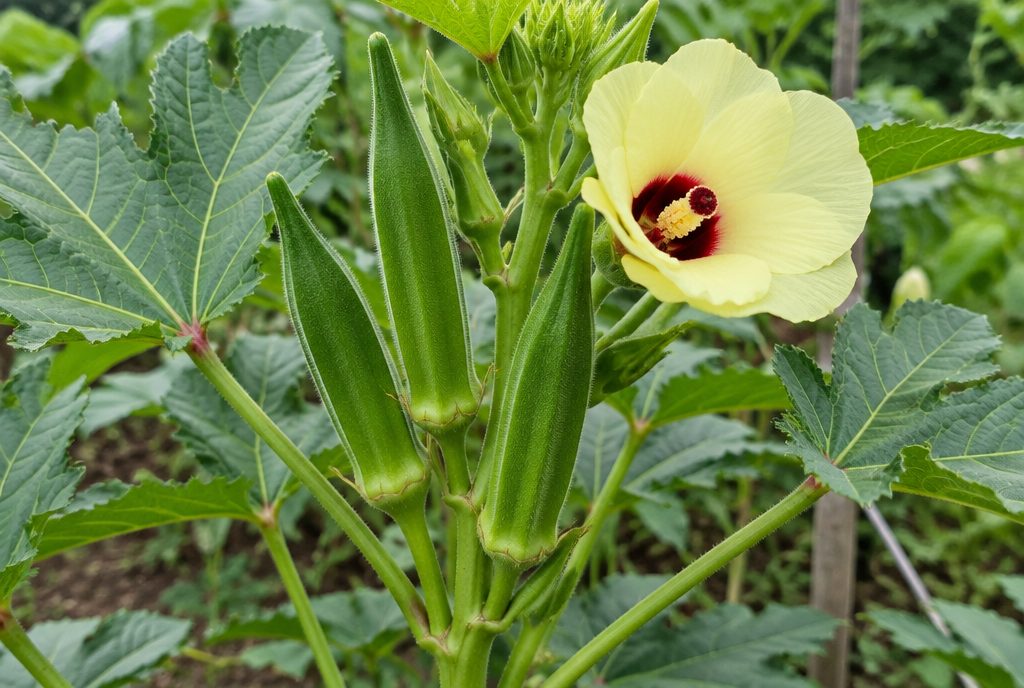
None of the four university sources we used says whether okra can be grown in containers, so this page cannot promise a pot recipe. What they do document is the plant’s needs: full sun, heat, fertile and well-drained soil, and steady water. A container can meet those, which is why this is worth trying, but every pot size and watering interval below the sourced numbers is our reasoning and is labeled as such. For the sourced growing method, start with our okra growing guide.
What is documented, and what is not
| Question | Our sources say |
|---|---|
| Can okra grow in a container? | Not addressed |
| Best pot size | Not addressed |
| Best potting mix | Not addressed; for beds, moist, well-drained, high in organic matter (NC State) |
| Watering in pots | Not addressed; for beds, 1–1.5 in. (2.5–4 cm) every 7–10 days in dry spells (UGA) |
| Yield from a pot | Not addressed |
We would rather leave the gaps visible than fill them with confident-sounding numbers.
What okra needs, from the sources
- Full sun. Texas A&M says okra must grow in full sunlight for good yields. Clemson adds good air movement to help reduce pod rot.
- Heat. Clemson says okra grows best between 75°F and 90°F (24–32°C), and UGA calls it a warm-season vegetable. Soil should be at least 65°F (18°C) at 4 in. (10 cm) before planting.
- Fertile, well-drained soil. Texas A&M says fertile and well-drained. NC State says moist, well-drained and high in organic matter. Clemson says to follow a soil test to keep pH between 5.8 and 6.5.
- Regular water. UGA says a deep soaking of 1–1.5 in. every 7–10 days is adequate in prolonged dry periods. Clemson says water frequently during high heat.
- Frequent picking. Clemson says pods must be harvested at least every two days.
Turning those needs into a container plan
Here is how we would apply the documented needs to a pot. This part is reasoning, not extension advice.
Give each plant room. In the ground, UGA thins to 1.5–2 ft (45–60 cm) apart and Texas A&M to about 1 ft (30 cm). Those numbers come from beds, but they show how much space a plant occupies. A pot much smaller than that footprint is more likely to leave a plant cramped. We have no sourced pot volume, so we will not state one.
Drainage is not optional. NC State says poorly drained soil can lead to root rot, and Clemson says seedling root-decay diseases are the most serious okra disease problem, especially in cold, wet soil. A container without drainage holes recreates exactly that problem.
Warm it, do not chill it. Clemson’s 75–90°F range and the 65°F soil minimum suggest a container should be set out only once nights and soil are warm. A pot’s temperature follows the air more closely than a bed does, which is our inference. Sow after the same soil-temperature test you would use in the ground.
Water by feel. Sourced intervals are for beds. Pots lose water faster, so a weekly deep soak is unlikely to be enough in high heat. Clemson’s “water frequently during high heat” is the sourced instruction; use your finger to decide what that means.
Pick on schedule. The every-two-days rule does not change in a pot.
Pests and diseases to expect
Our sources describe garden-bed problems, and some may not apply to pots.
- Root-decay diseases kill young seedlings (Clemson).
- Pod rot after flowers drop, reduced by full sun and good air movement (Clemson).
- Root-knot nematode galls (Clemson). Nematodes are soil organisms; whether fresh potting mix escapes them is something our sources do not say.
- Insects. NC State lists aphids, corn earworms, slugs, whiteflies and spider mites.
When a pot makes sense
A container is a practical route if you only have a patio or a bed that stays cold and wet. The conditions our sources worry about, cold wet soil and poor drainage, are ones you control in a pot. If you have a warm, sunny bed, the in-ground method in our okra from seed guide is the one with documented numbers.
When pods arrive, the rules in our okra harvesting guide apply either way: 2–3 in. long, picked at least every two days.
What would change this page
If you grow okra in a container and keep notes, the useful facts are the pot volume, the number of plants per pot, the days from sowing to first pod, and the yield. None of that is in our sources, and that is the gap this page cannot yet fill.
For a crop in our catalogue that does have sourced pot dimensions, see ginger in containers, and for the wider picture, our guide to vegetables in containers.
Frequently asked questions
Can you grow okra in a pot?
Our extension sources do not say. They describe okra grown in garden beds and rows. What they do document is what the plant needs, which is full sun, warmth of 75–90°F (24–32°C), well-drained and fertile soil, and regular water, and a container can supply all of those.
What size pot does okra need?
None of our sources gives a pot size. They do give in-ground spacing, about 1 ft (30 cm) per plant at Texas A&M and 1.5–2 ft (45–60 cm) at UGA, which is a reasonable guide to how much room each plant takes.
How often should I water container okra?
Our sources give in-ground figures only: UGA says 1–1.5 in. (2.5–4 cm) every 7–10 days in prolonged dry periods and Clemson says to water frequently during high heat. A pot dries faster than a bed, so check it often. That last point is our reasoning, not sourced advice.
Do I need to worry about root rot in pots?
Yes. NC State says poorly drained soil can lead to root rot, and Clemson says root-decay diseases that kill seedlings are the most serious okra disease problem, worse in cold, wet soil. Drainage holes and warm soil matter in a pot as in a bed.
Sources
- How to Grow Okra in South Carolina, Clemson Home & Garden Information Center
- Home Garden Okra, University of Georgia Extension
- Easy Gardening: Okra (EHT-058), Texas A&M AgriLife Extension
- Abelmoschus esculentus (Okra), NC State Extension Gardener Plant Toolbox