

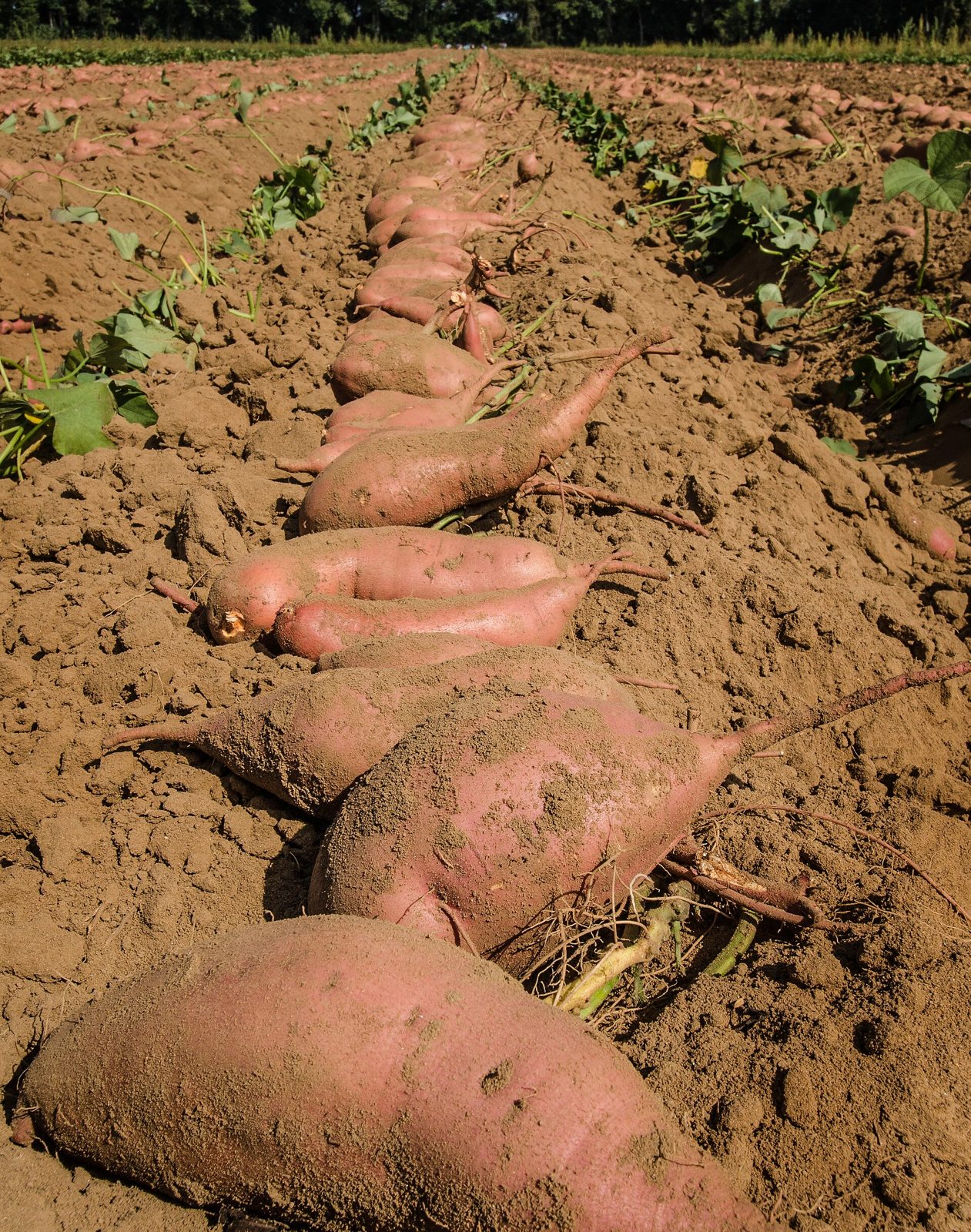
Dig sweet potatoes 90 to 120 days after planting, when the leaves start to yellow and before the first killing frost; cure them for one to two weeks in warm, humid conditions; then store them at 50–60°F (10–16°C). Curing is not optional. Penn State says it keeps the roots longer, heals wounds and improves quality, because the starch converts to sugar. This is the end of our sweet potato growing guide.
When to harvest
There are three cues, and our three sources give you all of them.
- Days. 90 to 120 days from planting the slips (Penn State, Clemson, UGA). Varieties differ: Clemson lists Beauregard at 90–100 days, Covington at 95–110 and Vardaman at 100.
- Leaves. Harvest when the leaves are beginning to turn yellow, before a light frost (Penn State).
- Size. Harvest when 30 percent of the roots are larger than 3½ in. (9 cm) in diameter (Clemson).
Two weather rules apply. UGA says to stop watering 3 to 4 weeks before harvest to prevent the tubers from splitting. And Penn State says the roots must be harvested before the first killing frost, since a hard frost can damage roots near the surface and soil temperatures below 50°F (10°C) lead to root rot.
How to dig sweet potatoes
- Find the crown. Penn State says to find the crown and dig out the tubers by hand.
- Loosen the soil with a fork. Loosen the soil below the roots. They will be in the top 8 to 10 in. (20–25 cm) of soil (Penn State).
- Be gentle. The tubers bruise easily and do not keep as well if broken or bruised (Penn State).
- Let them dry briefly. Ideally, let the potatoes dry for a couple of hours in the garden; if it is near or below freezing, dry them inside (Penn State).
- Do not wash them. Penn State says not to wash sweet potatoes before storing them.
How to cure sweet potatoes
The two sources recommend slightly different programs. Both are about heat and humidity.
| Source | Temperature | Humidity | Time |
|---|---|---|---|
| Clemson | 85°F (29°C) | 90 percent | One week |
| Penn State | 80–85°F (27–29°C) | 85–90 percent | Two weeks |
Penn State’s home method: place the roots in a single layer in plastic bags to keep humidity high, close the bags tightly, cut some slits for aeration and set them in a sunny part of the house where you can reach a high temperature of 80–85°F. Curing is done in two weeks.
Penn State adds a sweetening step: after curing, wrap the roots individually in newspaper, stack them in a box and leave them in a cool place such as a basement for six weeks.
How to store sweet potatoes
Store cured roots in a dark location at 50 to 60°F, where properly handled and cured sweet potatoes should keep well until spring (Penn State). Clemson says never expose them to temperatures below 50°F and never refrigerate them. The refrigerator is the wrong place for this crop.
Common harvest-time problems
- Splitting. UGA ties it to watering late in the season. Stop 3–4 weeks before harvest.
- Bruised roots. Penn State says they do not keep as well.
- Skin spots. Scurf is a fungal disease that appears as dark spots on the skin (Penn State). It is limited to the skin.
- Rodents. Penn State says voles, mice and deer can be a problem, and that growing in raised beds or large containers keeps rodents out.
- Wireworms and nematodes. Clemson says home gardeners may meet them.
What to do next
Save a few of your best roots if you want to make slips for next year; our sweet potato slips guide shows how. If you grow in pots, see the sweet potato container guide.
Planning other warm-season crops? Peanuts are also dug and cured, though with a different method; see our peanut harvesting guide.
Frequently asked questions
How do you know when sweet potatoes are ready?
Penn State says harvest when the leaves begin to turn yellow, before a light frost. Clemson says harvest when 30 percent of the roots are larger than 3½ in. (9 cm) in diameter. Both say 90–120 days from planting.
What happens if frost hits before I harvest?
Penn State says the roots must be harvested before the first killing frost, and a hard frost can damage roots near the surface. If a light frost burns the leaves, do not wait; if harvest has to wait, cut the vines so decay does not spread to the roots.
How do you cure sweet potatoes?
Clemson says expose the roots to 85°F (29°C) and 90 percent humidity for one week. Penn State says 80–85°F for two weeks. Do not wash them before curing.
Where should sweet potatoes be stored?
In the dark at 50–60°F (10–16°C), per Penn State. Clemson says never expose them to temperatures below 50°F and never refrigerate them.
Should I stop watering before harvest?
UGA says to stop watering 3 to 4 weeks before harvest to prevent the tubers from splitting.
Sources
- Sweet Potatoes, a Winning Vine for Your Garden, Penn State Extension
- Sweet Potato, Clemson Home & Garden Information Center
- Growing Guide: Sweet Potatoes, University of Georgia Extension