

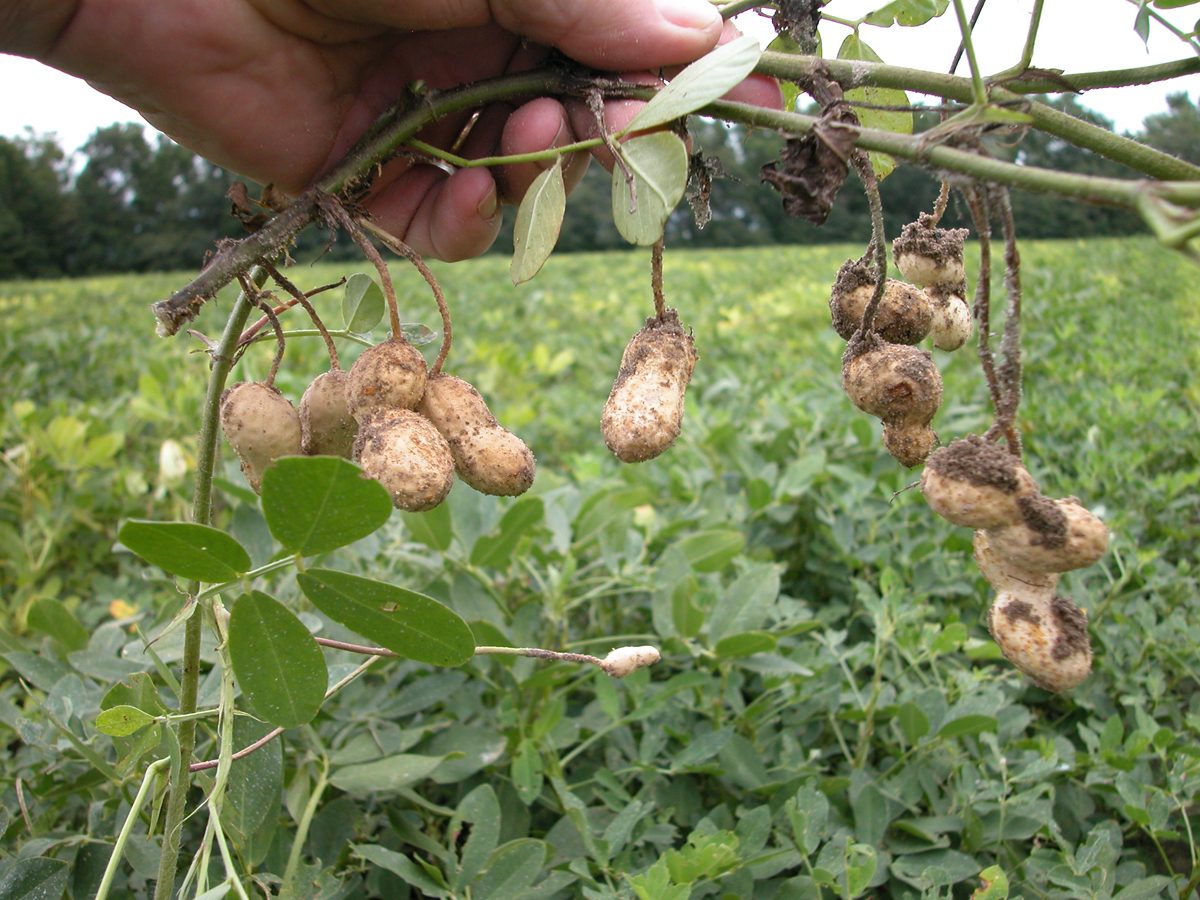
Harvest peanuts by checking the pods, not the calendar: lift a few plants about 120 to 150 days after planting, open the pods, and dig the bed when 65–70 percent are dark inside the hull. Then dry the plants in the sun for about a week, strip the pods and cure them two to three weeks in a cool, dry place. The pods are underground, so you cannot see ripeness without digging; the sample check is the method. This is the end of our peanut growing guide.
How to tell when peanuts are mature
Time gives a window. NC State’s Plant Toolbox says pods typically ripen 120–150 days after planting. UF/IFAS says runner peanuts mature in about 135–155 days. Clemson splits it by use: dry roasting peanuts can be harvested in 130–150 days, and green boiling peanuts in 90–110 days.
Pods give the answer. Clemson’s maturity check:
- Select three or four plants at random and lift them from the soil, taking care that the pods remain attached.
- Open a few pods. Pods not filled by the kernel are too young.
- Pods with a dark internal hull color are overmature.
- For dry roasting peanuts, harvest when at least 65 percent of the pods have turned dark inside the hull and the seed coats are pink to copper-red, or when 70 percent have a dark brown to black color in the scraped area.
UF/IFAS gives the same approach: if you plan to dry your crop, open a few pods before digging them all out and look for seeds that are turning darker, which indicates maturity.
Stop watering first
Clemson says to stop irrigating 10 days to two weeks before harvest. Water matters most from 60 to 110 days after planting, while pegs are entering the soil, but once the pods are filling it is time to ease off.
How to dig peanuts
- Do the sample check. Lift three or four plants, keep the pods attached and open some.
- Dig the plants. Lift whole plants from the soil with the pods still attached. NC State’s Plant Toolbox says after the first fall frost, dig up the plants and shake off the soil.
- Dry them off the ground. Spread the plants on a dry surface not touching the ground to cure before stripping the pods (NC State Toolbox).
- Dry in the sun for about a week. Clemson says to allow pods to partially dry in the sun for about a week.
- Strip the pods. Remove all pods from the vines.
- Cure two to three weeks. Spread them in a cool, dry area for continued curing (Clemson).
Curing, compared
| Source | Method | Time |
|---|---|---|
| Clemson | Partially dry in sun, strip pods, then cure spread in a cool, dry area | About a week, then 2–3 weeks |
| UF/IFAS | Pile plants and cure in warm, relatively dry weather, no rain | 5 to 10 days |
| NC State Toolbox | Spread dug plants on a dry surface off the ground, then strip pods | Not stated |
The sources describe curing the plants with pods attached (UF/IFAS, NC State) or partial drying then stripping and finishing on their own (Clemson). They agree on dryness and no rain; the days vary. Whatever you pick, Clemson’s rule applies: do not allow peanuts to mold while drying in the garden or in storage.
Storing peanuts
Clemson says to bag cured peanuts in loosely woven containers and hang them in a cool, dry area free of insects and rodents. Stored this way they may be kept for several months without a significant loss in quality.
Roasting-ready peanuts
Our sources describe the maturity point for dry roasting peanuts, 65–70 percent of the pods dark inside the hull, and for green boiling peanuts, 90–110 days after planting. They do not give roasting temperatures or times, so we have left them out. Dry, cured pods are the starting point for any roasting you do.
Common problems at harvest
- Mold. Clemson says not to allow peanuts to mold while drying in the garden or in storage.
- Pods left in the ground. Pods come off easily when stems weaken, so dig at once if that happens (Clemson).
- Disease. UF/IFAS names leaf spots, tomato spotted wilt virus and white mold as the three major diseases.
Next steps
If you want to understand why the pods are underground in the first place, see how peanuts grow. Container growers should read peanuts in containers. And if you grow sweet potatoes too, their curing is warmer and shorter; compare with our sweet potato harvesting guide.
Another crop dug when the plant tells you is turmeric: its leaves dry out and wilt before the rhizomes come up (Penn State), and the rhizomes are stored cool and dry at 50–60°F (10–16°C) (CTAHR). See our turmeric harvesting guide.
Frequently asked questions
How do you know when peanuts are ready to dig?
Lift three or four plants at random, keeping the pods attached, and check them. Clemson says pods not filled by the kernel are too young, and pods with a dark internal hull color are overmature. Dry peanuts are ready when 65–70 percent of the pods are dark inside.
How many days until peanuts are ready?
NC State's Plant Toolbox says 120–150 days after planting. UF/IFAS says runner peanuts need about 135–155 days. Clemson says 130–150 days for dry roasting peanuts and 90–110 days for green boiling peanuts.
How do you dry and cure peanuts?
Clemson says to let pods partially dry in the sun for about a week, remove them from the vines, and spread them in a cool, dry area for two to three more weeks. UF/IFAS says cure piled plants for 5 to 10 days of warm, dry weather with no rain.
When should I harvest immediately?
Clemson says to begin at once, regardless of hull color, if pod stems are weak so that pods come off the plants easily when lifted, or if the plants have yellowed and lost most of their leaves.
How long do homegrown peanuts keep?
Clemson says peanuts cured and bagged in loosely woven containers, hung in a cool, dry area free of insects and rodents, may be kept for several months without a significant loss in quality. Do not allow peanuts to mold while drying or in storage.
Sources
- Peanut, Clemson Home & Garden Information Center
- Peanuts, UF/IFAS Gardening Solutions
- Arachis hypogaea (Peanut), NC State Extension Gardener Plant Toolbox
- Peanut Production Practices (2024 Peanut Information), NC State Extension