
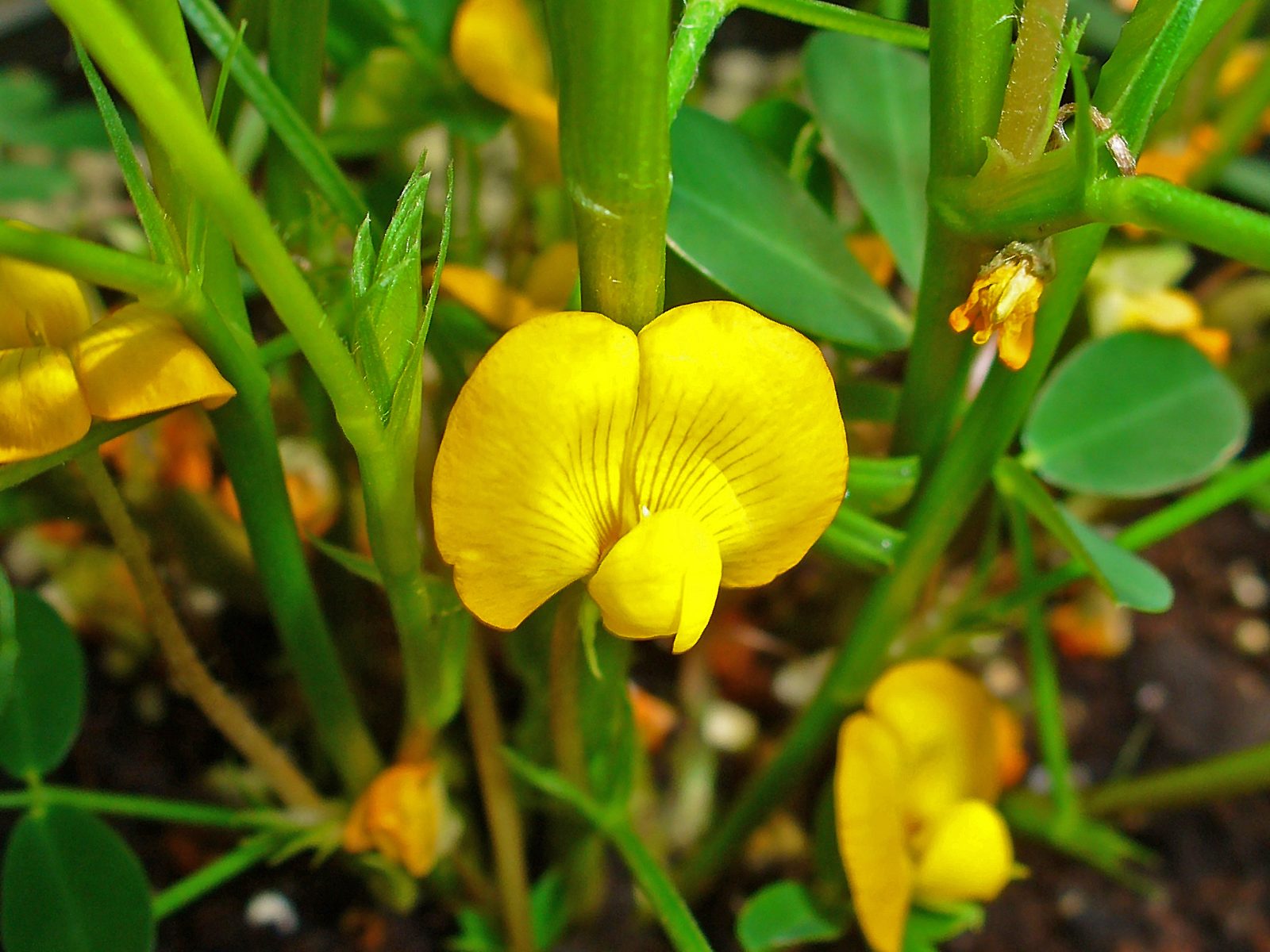
None of our university sources says whether peanuts can be grown in a container, so we cannot give you a tested pot recipe. What they do give is a clear list of what the plant needs, and a pot has to meet each item. The unusual one is the pegging zone: NC State says pegs cannot survive high soil temperatures, which matters more in a sun-baked container than in a bed. Read this page alongside our main peanut growing guide.
What is documented, and what is not
| Question | Our sources say |
|---|---|
| Can peanuts grow in containers? | Not addressed |
| Pot size or depth | Not addressed |
| Peanut plant size | 9 in. to 1.5 ft (23–46 cm) tall and wide (NC State Plant Toolbox) |
| Spacing in the ground | 6–9 in. apart (NC State Toolbox) · 4–6 in. apart (UF/IFAS) |
| Potting mix | Not addressed; for the ground, well-drained, pH 5.8–6.2 (NC State) |
| Watering a pot | Not addressed; for the ground, see below (Clemson) |
| Yield | Not addressed |
What the plant needs
- Full sun and good drainage. UF/IFAS says peanuts grow best on well-drained soils and in full sun, and that diseases are prevalent and yields low on poorly drained soils.
- Warm soil to start. 65°F (18°C) at 4 in. at noon for three days (NC State), or a 68°F daily average (UGA).
- A pH of 5.8–6.2 (NC State). UF/IFAS says to add lime below 5.8, aiming for 6.2–6.5.
- Calcium where the pods form. NC State says the peg and developing pod absorb calcium directly from the soil, so it must be readily available.
- Cool soil in the pegging zone. Pegs cannot survive when soils have high temperatures, and rapid canopy closure results in cooler soil temperatures there (NC State).
- Steady water at the right time. Clemson says water is most critical 60 to 110 days after planting, while pegs enter the soil, and that you should avoid wetting the leaves.
- A dry-down. Stop irrigating 10 days to two weeks before harvest (Clemson).
Turning those needs into a container plan
Everything here is our reasoning from the list above.
Choose depth over width. The pods form below ground, and Clemson plants seed 2–3 in. deep in sandy soil. The pegs also need room to move downward from the flowers into the mix. A shallow tray gives them little space, but no source gives a number. Choose a deep pot rather than a wide one, and fill it with loose, well-drained mix.
Mind the heat. NC State says high soil temperatures kill pegs. A dark pot in full afternoon sun can heat its mix well past the air temperature, which is general container behavior, not something our sources test. A light-colored pot, or shading the sides while keeping the foliage in sun, are practical responses. The sources do not mention either.
Do not skip calcium. The sources say calcium must be readily available in the soil where the pods form. Whether common potting mixes provide it is not addressed, so check the label or ask your state extension office.
Space the plants. In the ground, NC State’s Plant Toolbox says 6–9 in. between plants and UF/IFAS says 4–6 in. With a 9–18 in. plant width, plants packed tighter than that risk crowding. How many plants per pot is not documented.
Water by feel, at the right time. Clemson’s key window is 60–110 days after planting. A pot dries faster than a bed, so check it often during the window. Our sources give no pot watering interval.
Harvesting from a pot
Do the same maturity check: lift a plant, keep the pods attached, open a few and look at the inside of the hull (Clemson). Dry peanuts are ready when 65–70 percent of pods are dark inside. Then dry the plants in the sun about a week, strip the pods, and cure two to three weeks in a cool, dry place. The details are in our peanut harvesting guide.
Should you try it?
A container makes sense when you have sun and a patio but no bed, and when you are willing to treat the first season as a trial. Peanuts need a long warm summer (NC State Plant Toolbox): 120–150 days from planting to ripe pods. If your growing season is short, a pot will not change that.
If your garden has a warm, well-drained bed, use the in-ground method, which has sourced numbers. For a better understanding of why the pods hide underground, see how peanuts grow. For another warm-soil crop with partial container advice, see sweet potatoes in containers.
Frequently asked questions
Can you grow peanuts in a pot?
Our sources do not say. They describe peanuts in garden beds and fields. They do say the plant is compact, 9 in. to 1.5 ft (23–46 cm) tall and wide per NC State's Plant Toolbox, and that its needs are full sun, well-drained soil, available calcium and cool soil where the pegs form, all of which a container has to provide.
What size pot do peanuts need?
None of our sources gives a pot size or volume. NC State's Plant Toolbox gives a plant width of 9 in. to 1.5 ft and says to plant 6–9 in. apart, which shows how much space each plant takes. The depth the pods need is not stated.
Will a pot overheat the pegs?
Possibly, though our sources do not test pots. NC State says pegs cannot survive high soil temperatures, and that a closing canopy cools the pegging zone. A dark container in strong sun is a heat risk; that last point is our reasoning, not sourced.
How do I harvest peanuts from a pot?
Clemson says to lift plants from the soil with the pods still attached, then dry and cure them. Our sources do not describe harvesting from a container, so treat tipping the pot out as our suggestion.
Sources
- Arachis hypogaea (Peanut), NC State Extension Gardener Plant Toolbox
- Peanut Production Practices (2024 Peanut Information), NC State Extension
- Peanut Production Guide: Management and Cultural Practices for Peanuts (AG497), UF/IFAS Extension
- Peanut, Clemson Home & Garden Information Center