
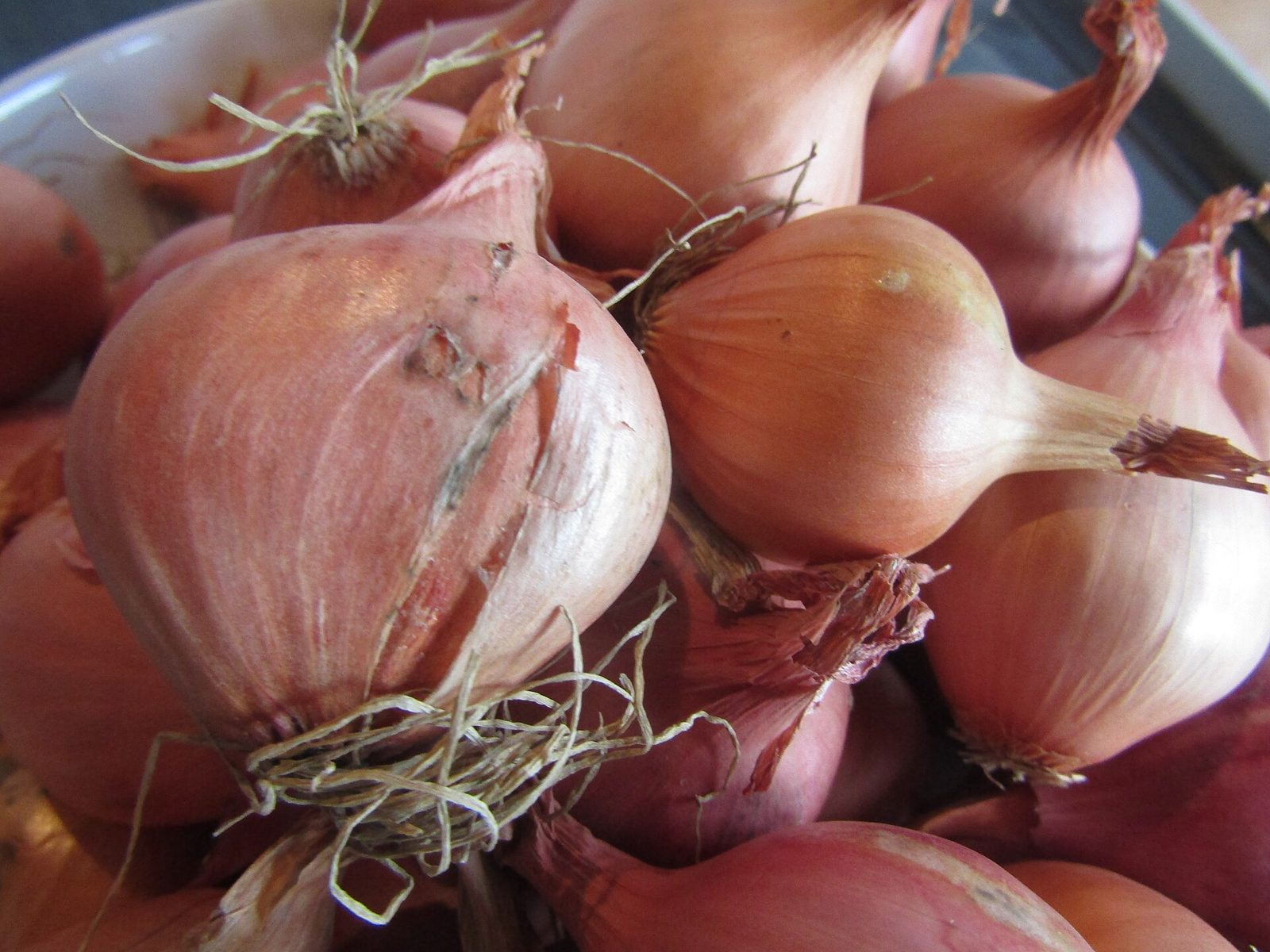
Harvest dry shallot bulbs after the tops fall over, cure them for one to two weeks until the skins are papery, then store them cool and dry; they keep for six months or longer. Green shallots can be pulled much earlier, once the tops are 6–8 in. (15–20 cm) tall. This guide is part of our shallot growing guide.
Two harvests from one planting
Shallots give you two crops, and you can take both.
Green shallots. Utah State says shallot tops can be harvested throughout the year to thin out plants when the tops are 6–8 in. (15–20 cm) tall, roughly 50–60 days after planting. Virginia Tech says about 6 weeks, and Clemson says 60 days. Clemson adds that green shallots can be stored in the refrigerator for up to two weeks. Harvesting some this way also thins the planting, and Utah State notes that tight spacing gives single bulbs and wide spacing gives clusters.
Dry bulbs. Utah State says to harvest after the tops of the plants fall over. Virginia Tech says to harvest mature bulbs when the tops have turned yellow and the bulbs are 1–1.5 in. (2.5–4 cm) in diameter, usually mid- to late summer. Iowa State says late summer, when the tops have yellowed and begun to dry. Clemson puts fall plantings at late spring, after the tops have died down completely.
How to harvest dry shallots
- Wait for the tops. Let the tops yellow and fall over. Mature, dry bulbs are dug after the tops die back (Virginia Tech).
- Dig the clumps. Each planted bulb produces a cluster of bulbs (Arkansas Extension), so you are lifting a handful of shallots, not one.
- Cure them. Cure 1–2 weeks. Utah State says to leave them in the garden to cure. Iowa State says a warm, dry location. Virginia Tech says a warm, dry place for about a week.
- Check that they are dry. The bulbs and leaves should be completely dry and the skin papery after curing (Utah State).
- Trim and bag. Iowa State recommends trimming the tops and storing the bulbs in mesh bags.
Curing shallots
Sources agree on the signs even where they differ on the days. Utah State and Iowa State say 1–2 weeks and Virginia Tech says about a week, so judge by the bulbs, not the calendar: curing is done when the bulbs and leaves are completely dry and the skin is papery.
Utah State leaves them in the garden to cure, which works if the weather stays dry. Iowa State and Virginia Tech use a warm, dry spot. In a wet spell, our judgment is that the warm, dry spot is the safer choice, though the sources do not say so.
Storing shallots
Store cured shallots in a cool, dry area at 32–40°F (0–4°C) and 60–70 percent relative humidity (Virginia Tech, Iowa State), in mesh bags. When properly cured and stored, shallots can be kept successfully for six months or longer (Iowa State).
Virginia Tech notes that smaller bulbs do not keep well. Use them first, or replant them. Utah State says properly stored shallot bulbs can be replanted in the spring, so the best of your harvest can seed next year’s bed. Our when to plant shallots page covers the planting windows.
What goes wrong at harvest
- Bulb rot. Overwatering contributes to bulb rot (Utah State), as do bruising and planting too deeply (Virginia Tech).
- Neck rot and soft rot. Virginia Tech lists both, with downy mildew, among shallot diseases.
- Thrips. Utah State says thrips hide where the leaf and bulb meet.
Shallots compared with garlic
Shallots are cued by the tops falling over; garlic is cued by leaves yellowing, with Penn State saying to harvest at 40–60 percent yellow. Garlic also cures longer, about three weeks, and stores colder at 32–35°F (0–2°C). If you grow both, our garlic harvesting guide has the details.
Frequently asked questions
How do you know when shallots are ready to harvest?
For dry bulbs, harvest after the tops of the plants fall over (Utah State). Virginia Tech says the tops turn yellow and the bulbs are 1–1.5 in. (2.5–4 cm) across, and Iowa State says late summer when the tops have yellowed and begun to dry.
Can you harvest shallot greens?
Yes. Virginia Tech says to harvest as green onions when the tops are 6–8 in. (15–20 cm) tall, about 6 weeks after planting. Utah State gives 50–60 days, and Clemson says 60 days.
How long do shallots need to cure?
Utah State and Iowa State say 1–2 weeks. Virginia Tech says about a week. The bulbs and leaves should be completely dry and the skin papery.
How long do shallots keep?
Iowa State and Virginia Tech say six months or longer when cured and stored at 32–40°F (0–4°C) and 60–70 percent relative humidity. Smaller bulbs do not keep well, so use them first or replant them.
Sources
- How to Grow Shallots in Your Garden, Utah State University Extension
- Onions, Garlic, and Shallots (SPES-788), Virginia Cooperative Extension
- How do I harvest, dry, and store shallots?, Iowa State University Extension
- Onion, Leek, Shallot and Garlic, Clemson Home & Garden Information Center