

Okra, sweet potato, peanut, luffa, lemongrass, ginger and turmeric all want warm weather, but our sources never give an upper temperature limit, so “heat tolerant” here means “needs a warm season”, not “survives a heat wave”. That is an honest reading of university extension advice. Each of these crops waits for warm soil or the end of frost, and most want full sun. This post shows what is documented for each, and where heat can become a problem.
What the sources say about heat
| Crop | What is documented | Heat caveat |
|---|---|---|
| Okra | Grows best at 75–90°F (24–32°C); warm-season vegetable (Clemson, UGA) | Water frequently during high heat (Clemson) |
| Sweet potato | Needs warm soil, 65–70°F or more (Clemson, Penn State, UGA); very sensitive to cool soil (Penn State) | No upper limit given |
| Peanut | Best grown in long warm summers; not frost-hardy (NC State) | Pegs cannot survive high soil temperatures (NC State) |
| Luffa | Warm-season; needs a frost-free season of at least 4 months (NC State) | Wants high moisture, but excess water harms it (UF/IFAS) |
| Lemongrass | Warm, humid conditions in full sun (Wisconsin) | Needs a great deal of water (Wisconsin) |
| Ginger | Tropical, needs warmth; 2–5 hours of direct sun (Texas A&M) | Do not let it dry out; no upper limit given |
| Turmeric | Grows best at 68–86°F (20–30°C) (CTAHR) | Sun advice differs by source |
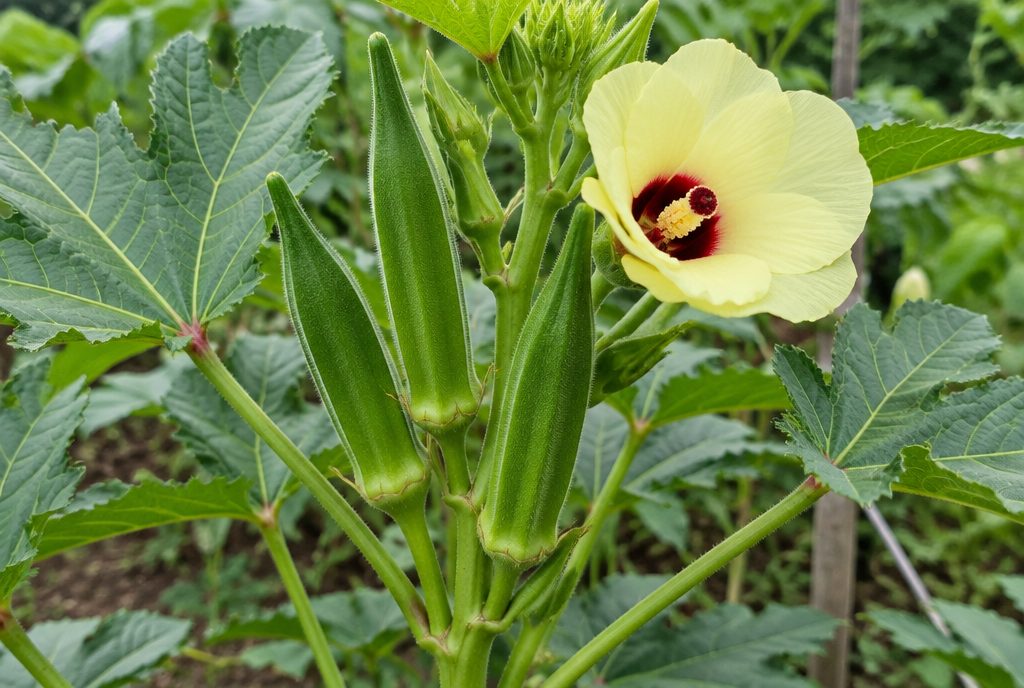
Okra: the best documented
Okra is the clearest heat crop in our guides. Clemson says it grows best between 75°F and 90°F, and UGA calls it a warm-season vegetable. Cold, wet soil is the way to fail (Clemson). In high heat, Clemson says to water frequently. Texas A&M offers the other view: okra does fairly well in dry conditions, but yields are higher with watering every 7 to 10 days. UGA says a deep soaking of 1–1.5 in. (2.5–4 cm) every 7 to 10 days is adequate in prolonged dry periods. Where you land in that range is your call, and our okra guide shows each number with its source.
Sweet potato and luffa: the long-season pair
Sweet potatoes want warm soil and a long frost-free run: 90 to 120 days from planting slips (Penn State, Clemson, UGA). Penn State says the vines cover the soil quickly and shade most weeds. Luffa asks for more calendar than heat: NC State says a frost-free season of at least four months, and gourds can take up to 200 days. Both are about how long the warm season lasts, not how hot it gets. See sweet potatoes and luffa.
Peanut: heat helps, then hurts
NC State says peanuts are best grown in areas with long warm summers and are not frost-hardy. But it also says pegs, which carry the developing pods into the soil, cannot survive high soil temperatures, and that a fast-closing canopy keeps the pegging zone cooler. Our peanut guide lists this as a problem card. Our sources do not say how to manage this in a home bed.
Lemongrass, ginger and turmeric: warm, not baked
Lemongrass wants warm, humid conditions in full sun to thrive (Wisconsin), and nights around 65°F (18°C) are Penn State’s stated preference. Ginger is a tropical plant, and Texas A&M asks for plenty of light with 2 to 5 hours of direct sun. Turmeric grows best at 68 to 86°F (CTAHR). Turmeric sun advice differs: CTAHR says full sun tolerating up to 40 percent shade, and Penn State says full sun in the morning and shade in the afternoon. In a very hot climate, afternoon shade is a sensible thing to test, though our sources do not say that heat is the reason.
Water is the common thread
Heat raises the water question for every crop here, and the sources answer it differently.
| Crop | Water figure | Source |
|---|---|---|
| Okra | 1–1.5 in. (2.5–4 cm) every 7–10 days in prolonged dry periods | UGA |
| Sweet potato | At least 1 in. a week, or a half inch a week after two weeks | Clemson, Penn State |
| Peanut | Most critical 60–110 days after planting, while pegs enter the soil | Clemson |
| Turmeric | 1.5–2 in. (4–5 cm) a week, every 5–7 days, in a commercial guide | CTAHR |
These are bed figures. Pots dry faster, and our pot pages say to check them more often. Stop watering peanuts 10 days to two weeks before harvest (Clemson) and sweet potatoes 3 to 4 weeks before (UGA).
What our sources do not tell you
None of our sources gives a maximum air or soil temperature for any of these crops, and none tests heat waves. They also say little about humidity, apart from lemongrass preferring it. If your summers regularly go well above 90°F, treat our advice as a starting point, and read your state extension office’s local guidance.
How to use this list
- Hot, long summers: okra is the best documented, then sweet potato.
- Short summers: luffa and peanut are the hardest, because both need a long warm season.
- Pots on a hot patio: ginger, turmeric and lemongrass, with water close at hand. See our guide to vegetables in containers.
- Warm soil first: read soil temperature for planting before you sow.
Looking for the quickest of the warm-season crops? See our fastest growing vegetables.
Frequently asked questions
What is the most heat tolerant vegetable on our list?
Okra is the best documented. Clemson says it grows best between 75°F and 90°F (24–32°C), and UGA calls it a warm-season vegetable. Our sources give no upper temperature limit for it or for any other crop here.
Do heat tolerant vegetables still need water?
Yes. Clemson says to water okra frequently during high heat. Wisconsin says lemongrass needs a great deal of water, and UF/IFAS says luffa wants high moisture but not excess. Texas A&M says okra does fairly well in dry conditions, though yields are higher with watering every 7 to 10 days.
Can heat hurt peanuts or turmeric?
Possibly. NC State says peanut pegs cannot survive high soil temperatures. For turmeric, CTAHR says full sun tolerating up to 40 percent shade, and Penn State says morning sun with afternoon shade, so in a hot climate a little afternoon shade is a reasonable test.
Sources
- How to Grow Okra in South Carolina, Clemson Home & Garden Information Center
- Easy Gardening: Okra (EHT-058), Texas A&M AgriLife Extension
- Arachis hypogaea (Peanut), NC State Extension Gardener Plant Toolbox
- Luffa, UF/IFAS Gardening Solutions
- Lemongrass, University of Wisconsin-Madison Extension Horticulture
- Hawai'i Turmeric Production Guidelines (VC-9), University of Hawaii CTAHR
- Sweet Potatoes, a Winning Vine for Your Garden, Penn State Extension